

When Trade Deals Turn Personal: Inside the US-Vietnam Partnership explores how the evolving trade relationship between the United States and Vietnam has grown into a deeply interconnected and human story, not just a matter of policy and numbers. The article opens in Hanoi’s Old Quarter, where a Vietnamese economist explains over bowls of pho how trade has become a lived experience far beyond spreadsheets. Trade with the United States has been essential to Vietnam’s economic modernization and serves as a practical model of alliance-building for the U.S.
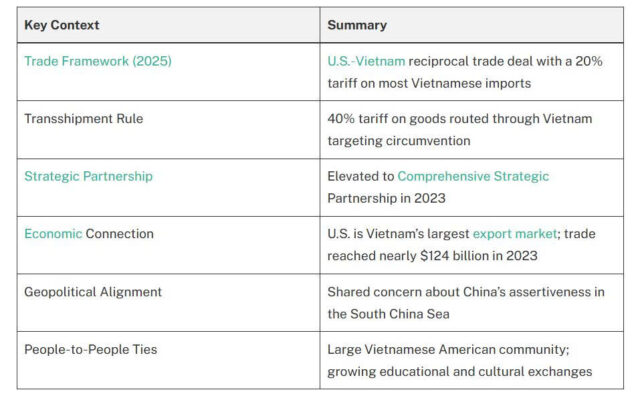
Tensions heightened by July 2025 when the U.S. proposed a 46% tariff on Vietnamese exports. Rather than confrontation, the two sides engaged in intense diplomacy, resulting in an agreement with a 20% tariff on most Vietnamese imports into the U.S. and an additional 40% tariff on goods believed to be transshipped through Vietnam to avoid trade restrictions, especially from China. This compromise was described as a “recalibration of goals,” facilitated by Vietnam’s “bamboo diplomacy”—a strategy of flexibility without losing sovereignty that helped prevent major trade disruption while supporting Vietnam’s industrial agenda.

Beyond Tariffs and Treaties: the U.S.–Vietnam Partnership Became “Personal”
The article highlights that the stakes are high: the U.S. is Vietnam’s largest export market, with exports nearing $124 billion in 2023. The enforcement of the transshipment rule encouraged Vietnam to strengthen its domestic supply chain and reduce reliance on Chinese components—a move seen by Prime Minister Pham Minh Chinh as necessary for “moving up the value chain.”
Beyond tariffs, emotional and historical ties also shape the partnership. Vietnam was alarmed in early 2025 when USAID funding for cleanup projects was briefly cut, an episode that underscored how deeply historical issues influence present diplomacy. Educational and cultural exchanges—including significant contributions by Vietnamese students to U.S. universities and Peace Corps involvement—have built personal trust over years.
Finally, the article frames the U.S.–Vietnam alliance as a broad partnership encompassing trade, security cooperation, tech transfer, and maritime initiatives. Both nations face similar challenges—protecting domestic industries, adapting to evolving supply chains, and ensuring equitable distribution of trade benefits. A minor shift in U.S. policy can impact Vietnamese factory workers’ hours and American soybean farmers’ season success, emphasizing how intertwined lives and livelihoods are on both sides of the Pacific
Cre: When Trade Deals Turn Personal: Inside the US-Vietnam Partnership – Fortune Herald
 EN
EN  VI
VI